
PVC Flanges Inch
What are Flanges and Why Are They Used?
-
In PVCu pressure pipe systems, a flange is used to create a bolted, demountable joint between sections of pipe or between a pipe and a valve, pump, tank, or other item of equipment.
-
A typical PVCu flanged joint consists of a stub flange solvent-welded onto the pipe, a backing ring (often galvanised steel or PVCu) to provide strength, a gasket to form the seal, and a set of bolts and nuts to clamp everything together. When the bolts are tightened evenly, the gasket is compressed between the mating faces, producing a secure, pressure-rated seal.
- Flanged joints can also be made using full face flanges, which act as the stub and backing ring in one piece, meaning simpler and more efficient installs.
Why:
- Unlike solvent-welded joints, which are permanent, a flanged connection can be taken apart and reassembled, making it ideal where access, maintenance, or future modification is required.
- Flanges also become more practical as pipe diameters increase, where solvent welding is harder to carry out accurately, and alignment becomes more critical. A flanged joint allows for controlled, even compression across a gasket, helping to maintain a reliable seal while tolerating minor misalignment and reducing stress on connected equipment.
Types of Flanges
There are multiple types of flanges; below is a small summary of the main types of flanges used in PVCu systems.
-
Stub flanges are designed to be solvent-welded directly onto PVC pipe, forming the flanged end of a bolted joint when used in conjunction with a backing ring, gasket and bolt set. The stub flange itself provides the sealing face, while the backing ring delivers the mechanical strength required for bolting. These are also available as a threaded option.
-
Full face flanges are flanges with a flat, uniform contact surface that runs right across the whole face of the flange. They eliminate the need for stub flanges and backing rings as they perform both roles, meaning just two full face flanges and a gasket are needed to join 2 pipes. The flat face design means the gasket makes contact over a large, even area, helping create a reliable seal without focusing stress on a small portion of the flange. These are also available with a threaded socket.
-
Blanking flanges are commonly used to terminate a pipeline or isolate sections for maintenance or testing. They are similar to full face flanges, but have no hole in the middle for a pipe to attach to, effectively sealing off the pipeline when used with a gasket.
Flange/Backing Ring Standards
As well as different types, flanges also come drilled to different standards. It is important to match flange standards when connecting flanged components. The standard refers to the pattern of the bolt holes; mismatching standards will not align correctly and provide a suitable seal. Common flange standards in the UK are:
-
EN 1092-1 (PN10/16): A European standard, very common for newer systems, identified as PN (Pressure Nominal) and then a number, which relates to the pressure rating of the flange.
-
ASA/ANSI: An American standard, often used in the oil, gas and chemical industries. Identified as "ANSI 150", meaning the fitting is rated to 150 lbs.
-
Table D/E: D/E is an older British standard still found in many industrial applications, but is not used in newer pipelines.
Do PVC flanges need gaskets?
How to Measure Flanges/Backing Rings
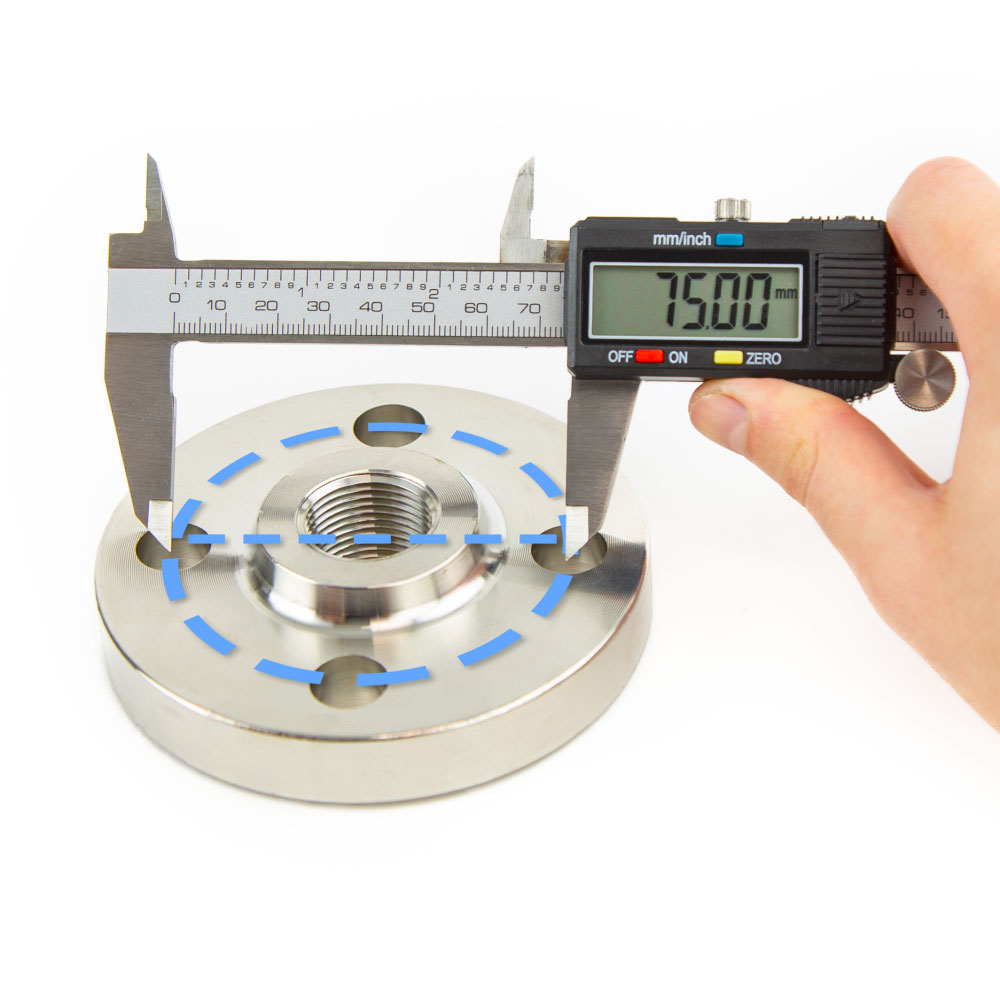
A flange size can be identified by the Pitch Circle Diameter (PCD). This is the diameter of a circle that passes through the centre of all of the bolt holes in a flange. It can also be referred to as the Bolt Circle Diameter (BCD).
Measurements Explained:
- Pitch Circle Diameter (PCD)
- The PCD of a flange helps ensure alignment between mating components, preventing leaks and providing even load distribution. The PCD is how you can determine the pattern of a flange (PN10/16, ANSI, D/E, etc.).
- Hole Diameter
- The size of the holes is relevant to ensuring the correct width of the bolt is used.
- Internal Diameter (ID)
- Inner diameter is the size of the hole in the middle of a flange; for a full-face flange, this would be the size of the socket, so it would be the size of the pipe to fit the flange.
- Outer Diameter (OD)
- The outer diameter of the flange.
Ensuring the correct measurements are made is critical to selecting the right flange for a use case. If you require any help or additional information, please contact us.
In this case, the PCD is 75mm, which lines up perfectly with a 3/4" (25mm) PN10/16 Flange as per the PCD Chart below.
| PN10/16 (BS EN1029-1) Flange Measurements | |||||
| Nominal Size (inch) | Nominal Size (mm) | Height (mm) | PCD (mm) | No. of Bolt Holes | Bolt Size |
| 1/2" | 20 | 95 | 65 | 4 | M12 |
| 3/4" | 25 | 105 | 75 | 4 | M12 |
| 1" | 32 | 115 | 85 | 4 | M12 |
| 1 1/4" | 40 | 140 | 100 | 4 | M16 |
| 1 1/2" | 50 | 150 | 110 | 4 | M16 |
| 2" | 63 | 165 | 125 | 4 | M16 |
| 2 1/2" | 75 | 185 | 145 | 4 | M16 |
| 3" | 90 | 200 | 160 | 8 | M16 |
| 4" | - | 220 | 180 | 8 | M16 |
| - | 110 | 220 | 180 | 8 | M16 |
| 5" | 140 | 250 | 210 | 8 | M16 |
| 6" | - | 285 | 240 | 8 | M20 |
| - | 160 | 285 | 240 | 8 | M20 |
| - | 200 | 340 | 295 | 12 | M20 |
| 8" | 225 | 340 | 295 | 12 | M20 |
| Table D&E (BS10) Flange Measurements | ||||
| Nominal Size (inch) | Height (mm) | PCD (mm) | No. of Bolt Holes | Bolt Size |
| 1/2" | 95 | 67 | 4 | M12 |
| 3/4" | 102 | 73 | 4 | M12 |
| 1" | 115 | 83 | 4 | M12 |
| 1 1/4" | 120 | 87 | 4 | M12 |
| 1 1/2" | 134 | 98 | 4 | M12 |
| 2" | 152 | 115 | 4 | M16 |
| 2 1/2" | 165 | 127 | 4 | M16 |
| 3" | 185 | 145 | 4 | M16 |
| 4" D | 216 | 178 | 4 | M16 |
| 4" E | 216 | 178 | 8 | M16 |
| 5" | 254 | 210 | 8 | M16 |
| 6" | 290 | 235 | 8 | M20 |
| 8" | 337 | 292 | 8 | M20 |
Downloads

If you require any further information, our excellent customer service team is here to help so please call us on 01794 835835.



