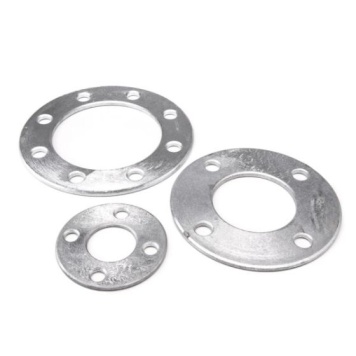
Backing Rings for PVCu Flanges Inch
PVCu Backing Rings for Stub Flanges
Backing rings for are a critical component in flanged pipework systems, providing the mechanical strength required to secure a reliable bolted joint. Designed to be used in conjunction with PVCu stub flanges, these backing rings distribute bolt loads evenly, helping to maintain alignment, sealing integrity, and long-term performance in a wide range of applications.
Manufactured from galvanised mild steel, the backing rings in this category are suitable for use with PVCu pressure systems where corrosion resistance, durability, and compatibility with recognised flange standards are essential.
Purpose and Function
Backing rings are installed behind PVCu stub flanges to provide rigidity and support during bolting. As PVCu itself is not designed to withstand high bolt loads, the backing ring ensures that tightening forces are absorbed by the steel component rather than the plastic flange.
This arrangement allows PVCu pipework to be securely connected to valves, fittings, and other flanged equipment while maintaining the chemical resistance and lightweight advantages of PVCu.
Material and Corrosion Protection
Most backing rings in this range are manufactured from mild steel and finished with a galvanised coating. This zinc coating provides effective protection against corrosion in typical indoor and outdoor environments, extending service life and reducing maintenance requirements. When paired with PVCu stub flanges, the combination offers an excellent balance of strength and corrosion resistance.
In addition to galvanised steel variants, a PVCu backing ring option is also available. This backing ring is designed for applications where metal components are not suitable, such as chemically aggressive environments or systems requiring full plastic compatibility.

Flange Standards
It is important to match flange standards when connecting flanged components. The flange standard refers to the pattern of the bolt holes; mismatching standards will not align correctly and provide a suitable seal. Common flange standards in the UK are:
- EN 1092-1 (PN10/16): A European standard, very common for newer systems, identified as PN (Pressure Nominal) and then a number, which relates to the pressure rating of the flange.
- ASA/ANSI: An American standard, often used in the oil, gas and chemical industries. Identified as "ANSI 150", meaning the fitting is rated to 150 lbs.
- Table D/E: D/E is an older British standard still found in many industrial applications, but is not used in newer pipelines.
Key Features and Benefits
-
Structural support: Provides the strength required to securely bolt PVCu stub flanges without damaging the plastic component.
-
Standards compatibility: Available to BS4504, BS10, and ASA or ANSI 150 specifications for flexible system integration.
-
Corrosion resistance: Galvanised finish helps protect against rust and environmental exposure.
-
Versatile applications: Suitable for pressure-rated PVCu pipe systems across industrial and commercial sectors.
-
Cost-effective solution: Enables the use of lightweight PVCu pipework while maintaining secure flanged connections.
Typical Applications
PVCu backing rings for stub flanges are widely used across multiple sectors, including:
-
Water and wastewater treatment
-
Chemical processing and dosing systems
-
Industrial fluid handling
-
Agriculture and irrigation
-
Commercial and utility pipework installations
Their compatibility with recognised flange standards makes them suitable for both new installations and system upgrades.
How to Measure Flanges
A flange size can be identified by the Pitch Circle Diameter (PCD). This is the diameter of a circle that passes through the centre of all of the bolt holes in a flange. It can also be referred to as the Bolt Circle Diameter (BCD).
Measurements Explained:
- Pitch Circle Diameter (PCD)
- The PCD of a flange helps ensure alignment between mating components, preventing leaks and providing even load distribution. The PCD is how you can determine the pattern of a flange (PN10/16, ANSI, D/E, etc.).
- Hole Diameter (Hole Dia)
- The size of the holes is relevant to ensuring the correct width of the bolt is used.
- Internal Diameter (ID)
- Inner diameter is the size of the hole in the middle of a flange; for a full-face flange, this would be the size of the socket, so it would be the size of the pipe to fit the flange.
- Outer Diameter (OD)
- The outer diameter of the flange.
Ensuring the correct measurements are made is critical to selecting the right flange for a use case, if you require any help or additional information, please contact us.
Downloads

If you require any further information, our excellent customer service team is here to help so please call us on 01794 835835.