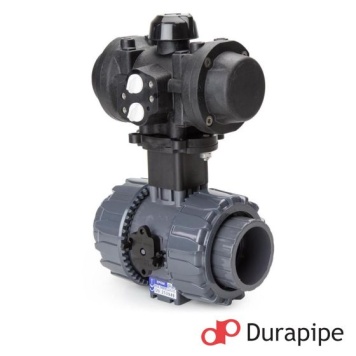
Pneumatic Ball Valves
In automated pipe systems where speed, reliability and repeatability matter, pneumatic actuated ball valves provide a robust and cost-effective solution. Designed to deliver fast operation using compressed air, these valves are widely used in industrial process control, water treatment, chemical handling and manufacturing environments.
Within this category, we supply high-quality pneumatically actuated ball valves from leading manufacturers, including Georg Fischer and Durapipe, available in 2-way and 3-way configurations to suit a wide range of flow control requirements.
Whether you are upgrading a manual system or designing a fully automated installation, pneumatic actuation offers reliable, low-maintenance performance with excellent response times.
Key Applications Include:
-
Industrial water treatment systems
-
Chemical dosing and transfer lines
-
Compressed air systems
-
Process automation
-
Manufacturing and production plants
-
Irrigation and agricultural control systems
What Is a Pneumatic Actuated Ball Valve?
A pneumatic-actuated ball valve combines two core components:
-
A ball valve (2-way or 3-way)
-
A pneumatic actuator powered by compressed air
When air pressure is applied to the actuator, it rotates the internal ball 90 degrees, opening or closing the flow path. Because the movement is rapid and decisive, these valves are ideal for applications requiring frequent cycling or quick shut-off.
Unlike electric-actuated valves, pneumatic systems do not rely on motors. Instead, they use air pressure, which makes them particularly well-suited to industrial environments where compressed air is already available.
How Does a Pneumatic Ball Valve Work?
Inside the valve body is a precision-machined ball with a bore through its centre.
-
Open position: The bore aligns with the pipeline, allowing full flow.
-
Closed position: The ball rotates 90 degrees, blocking the flow completely.
The pneumatic actuator converts air pressure into rotary motion. Depending on the actuator type:
-
Double-acting actuators use air to both open and close the valve.
-
Spring return actuators use air in one direction and a spring for automatic fail-safe return.
This makes pneumatic actuated valves ideal for applications requiring automatic shut-off during power or air failure.
Why Choose Pneumatic Actuation Over Electric?
Both electric and pneumatic actuation have their place, but pneumatic valves offer distinct advantages:
-
Faster actuation speed
-
High cycle durability
-
Suitable for hazardous or explosive environments
-
Lower actuator cost in compressed air systems
-
Simpler mechanical design
In environments where compressed air infrastructure already exists, pneumatic actuation is often the most efficient and economical solution.
If you require any further information, our excellent customer service team is here to help so please call us on 01794 835835.