
Vulcathene Double Y Branch 45°

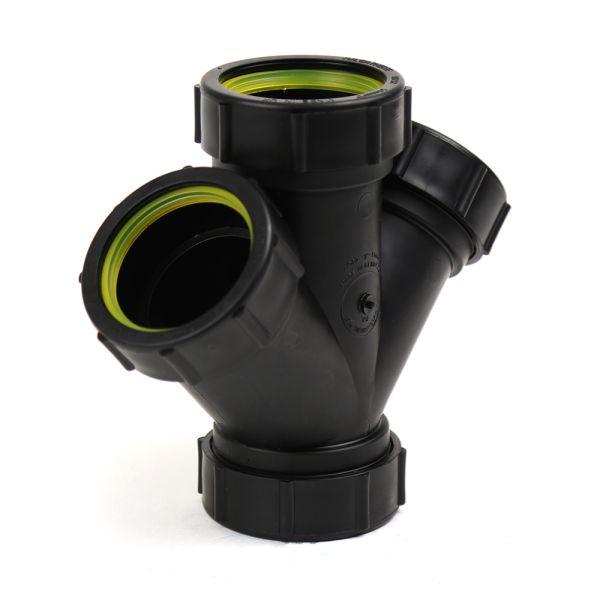
What is a Vulcathene Double Y Branch 45° used for?
The Vulcathene Mechanical Double Y Branch 45° fitting is ingeniously designed for laboratory drainage systems, enabling the connection of four pipes in a dual Y configuration. This fitting is crucial for complex piping networks, allowing for the integration of multiple branch lines into the main system at a 45° angle, which helps to ensure a smooth and efficient flow of chemical waste.
Key Features
- Chemical Resistance: Engineered for use in laboratory drainage systems, Vulcathene mechanical fittings offer outstanding resistance to a wide range of chemicals, ensuring durability and reliability in environments where chemical waste is handled.
- Efficient Jointing: Provides a simple, fast, and efficient method for pipe jointing, optimizing installation time and system reliability.
- Fully Demountable: Designed for ease of disassembly, Vulcathene fittings offer unparalleled flexibility for system modifications or maintenance, allowing for repeated removal and re-installation without compromising the fitting's efficiency.
- UV Protection: Equipped with UV-resistant properties to ensure long-term durability and protection against environmental factors.
- Unique Jointing Method: Features a nut and tongued-olive mechanism for easy installation and a tight, leak-proof connection.
Specifications
- Product Codes: V1038101, V1038201, V1038301, V1038401
- Available Sizes: 38mm, 51mm, 76mm, 102mm
- Approvals: BBA 24/7091
- Material: Black Co-Polymer PP (a unique composite engineered for chemical resistance and UV protection).
- Temperature Range: Suitable for temperatures from -20°C to +100°C.
- Applications: Laboratory drainage.
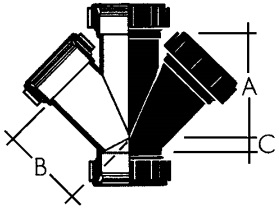
| Product Code | Manufacturer Code | Nominal Size (mm) | A (mm) | B (mm) | C (mm) | Weight (g) |
| 376953 | V1038101 | 38 | 86 | 64 | 8 | 180 |
| 376954 | V1038201 | 51 | 91 | 76 | 17 | 288 |
| 376955 | V1038301 | 76 | 177 | 152 | 43 | 800 |
| 376956 | V1038401 | 102 | 213 | 178 | 49 | 1600 |
How to Install Vulcathene Mechanical Fittings
Creating a secure mechanical joint with Vulcathene fittings involves a precise and methodical process to ensure optimal joint integrity and system performance. Follow these steps for installation:
- Cutting the Pipe:
- Use a rotary plastic pipe cutter for a clean, burr-free cut. Clamp the pipe to avoid distortion.
- Ensure the cut is square. If a hacksaw is used, remove all burrs and loose material.
- Groove the pipe using the appropriate grooving tool for the tongued olive to fit in.
- Grooving:
- Insert the pipe fully into the grooving tool.
- Adjust the blade depth to about half and rotate the tool anti-clockwise around the pipe.
- Increase the blade to full depth, continue rotating, then remove the tool and clear any swarf.
- Assembling the Joint:
- Slide the nut onto the pipe, with the threaded side facing the groove.
- Insert the olive (widest end first) into the groove. Use Vulcathene lubricant for ease, especially with larger sizes.
- Ensure the olive is correctly seated and the fitting thread is clean. Apply lubricant to the fitting threads.
- Loosely assemble the joint and hand-tighten the nut using two Vulcathene spanners, then tighten fully to ensure a secure fit.
Note:
- Tighten nuts progressively during installation, not all at once at the end.
- Use the Vulcathene grooving tool and spanners to guarantee the joint's integrity.
For detailed instructions, it's crucial to refer to the Vulcathene Installation Guide.
Downloads

If you require any further information, our excellent customer service team is here to help so please call us on 01794 835835.
