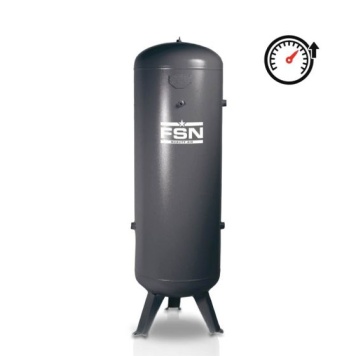
Vertical Air Receivers
A vertical air receiver - sometimes referred to simply as an air receiver tank - is a pressure vessel installed in a compressed-air system to provide a buffer between the compressor and downstream usage. It acts much like a storage “reservoir” of pressurised air, enabling the system to:
- Smooth out pressure fluctuations, especially when demand surges
- Reduce the number of compressor starts and stops (improving efficiency and lifespan)
- Allow condensate to drop out of the system before the air proceeds downstream
- Provide a reserve of air that helps maintain stable pressure during peak use
Because it is oriented vertically, it has a small footprint compared to a horizontal version, making it ideal for plant rooms or workshops with limited floor space.
In effect, you can think of the air receiver like a “battery” for compressed air - it stores energy (air under pressure) ready for use when needed.
FSN Painted Vertical Air Receiver
This is the standard painted-finish model offering a robust, general-purpose option for industrial compressed air systems.
Key details:
- Working pressure: up to 11 bar (some up to 12 bar) with maximum pressure values around 160–174 psi
- Outlet BSP size ranges from ¾″ to 3″
- Vertical orientation saves floor space, making it suitable for plant rooms, workshops and systems where space is at a premium
- Supplied with a fittings kit for straightforward installation
- Painted finish adds a layer of corrosion protection for general industrial use
Use case:
Ideal for a standard workshop compressed air system where ambient conditions are typical and the receiver doesn’t face severe corrosive or outdoor conditions.
FSN Painted High-Pressure Vertical Air Receiver
This variant is designed for higher-pressure applications where system pressures exceed standard levels.
Key points:
- Working pressure up to 16 bar (or 15 bar in some models) with maximum pressure values around 232 psi
- Available in capacities from 200 L upwards in the high-pressure range
- Painted finish remains, so suitable where corrosion is moderate but elevated pressure demands exist
Use case:
When your compressor or downstream equipment operates at higher pressures (e.g., heavy-duty industrial uses) and you need a receiver rated accordingly.
FSN Galvanised Vertical Air Receiver
This model addresses environments where corrosion resistance is a key concern. The galvanised finish offers superior protection compared to painted steel.
Highlights:
- Working pressure up to 11 or in some cases 12 bar (maximum around 160–174 psi)
- Finish: fully galvanised steel (zinc coating) to stand up to harsher ambient conditions
- Vertical orientation retains the space-saving benefits
Use case:
Ideal for workshops or plant rooms where humidity, external weather exposure or corrosive atmospheres (salt spray, chemical exposure) are present.
FSN Galvanised High-Pressure Vertical Air Receiver
For the most demanding situations - high pressure and high corrosion resistance.
Key features:
- Rated up to 16 bar (maximum approx. 232 psi) in a galvanised finish
- Combines heavy-duty pressure capability with galvanised steel protection
Use case:
For industrial plants, offshore or coastal applications, or any compressed air system that must withstand elevated pressures in aggressive environments.
How to Install an Air Receiver Tank
Installing an air receiver is straightforward when planned correctly; here are the key steps and best-practice considerations presented in a clear, professional yet accessible manner:
1. Pre-installation checks
- Verify the receiver’s specification (working pressure, maximum pressure, outlet size) matches your compressor and downstream system requirements
- Ensure you have a suitable location: flat, stable floor or base, appropriate lifting access, and clearance for service (valves, drain, gauge)
- Confirm whichever finish (painted or galvanised) is suitable for the environment (corrosive vs general)
- Ensure pipework and connections (outlet size, BSP/thread type) match the receiver’s provisions
2. Positioning
- Place the receiver in the chosen spot, ensuring it’s level and anchored as required (especially for large sizes)
- Leave sufficient clearance around the vessel for maintenance - drain valve access, safety relief valve, gauge view
- Ensure lifting equipment and rigging is available if the receiver is large/heavy
3. Connections & commissioning
- Connect the receiver outlet to the compressed-air system using appropriate pipework of correct size (as per the receiver’s outlet specification)
- Install a safety relief valve, a pressure gauge, and an automatic drain to the vessel base. These are included in the accompanying receiver kits
- Ensure all connections are pressure-tested (to appropriate test pressure) before connecting to the compressor
- Slowly bring the vessel into service: open the supply line, allow the vessel to fill, check for leaks, and confirm stable pressure build-up
4. Operational checks
- Monitor the system pressure and ensure the receiver holds pressure as expected without undue drop when demand surges
- Regularly drain condensate via the base valve (at least daily, or as per system requirements) - this helps prevent corrosion and downstream water contamination
- Inspect the exterior finish (paint or galvanised) periodically for signs of corrosion or coating damage; early remedial action extends service life
- Check safety relief valve functionality at defined intervals (in line with your maintenance regime and relevant pressure-vessel regulation) to ensure safe operation
If you require any further information, our excellent customer service team is here to help so please call us on 01794 835835.