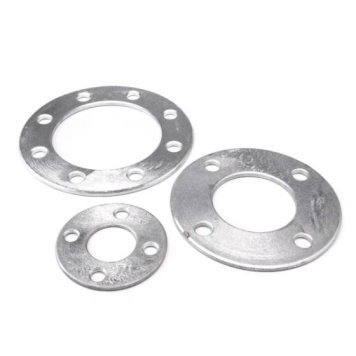
Backing Rings
These galvanised steel backing rings are designed to provide the strength and rigidity needed when assembling ABS flanges with gaskets and bolt sets. Positioned behind the flange during installation, the backing ring ensures even compression across the gasket face, creating a secure, leak-free bolted joint.
Manufactured from robust galvanised steel, these backing rings offer excellent corrosion resistance, making them suitable for long-term use in industrial, commercial and water-based pipework systems. They are compatible with both imperial and metric ABS flanges of the same size and are commonly used in conjunction with BZP or stainless steel bolt sets for a complete flange assembly.
Available in three industry-standard drilling patterns, this range allows you to match existing pipework systems with confidence:
- BS EN 1029-1 PN10/PN16
- BS 10 Table D & Table E
- ASA/ANSI Class 150
How Galvanised Steel Backing Rings Are Used
Backing rings play a critical structural role in bolted ABS flange assemblies. They sit behind the ABS flange, with the gasket positioned between the it and the opposing full-face flange. Once the bolt set is tightened, the backing ring acts as a rigid compression plate, allowing the bolts to be evenly tightened without distorting or damaging the plastic flange.
This method of assembly ensures:
- Even compression across the full gasket face
- Reduced risk of flange deformation under load
- A stronger, more reliable mechanical joint
- Improved long-term sealing performance under pressure and vibration
Backing rings are always matched to:
- The same nominal bore size as the ABS flange
- The correct drilling pattern (BS EN 1029-1, BS 10 D/E or ASA 150)
- The appropriate bolt set and gasket for the application
Without a backing ring, plastic flanges would be vulnerable to flexing and uneven load distribution, increasing the risk of leaks or joint failure. Used correctly, galvanised backing rings ensure your ABS flange connections remain secure, aligned and pressure-resistant over the long term.
Understanding the Different Drilling Patterns
Choosing the correct drilling pattern is essential, as flange bolt hole configurations are not interchangeable between standards.
BS EN 1029-1 PN10/PN16
- Modern European flange standard
- Metric-based bolt circle and hole spacing
- Compatible with both PN10 and PN16 pressure-rated flanges
- Commonly used in modern UK and European pipework installations
BS 10 Table D & Table E
- Older British Standard (BS 10:1962)
- Imperial-based drilling
- Table D is typically used for lower pressure systems
- Table E is suitable for higher pressure applications
- Still widely found on legacy installations and industrial systems
ASA/ANSI Class 150
- American flange standard
- Imperial bolt spacing with different bolt circle dimensions to BS standards
- Frequently used on imported equipment, pumps and valves
- Common in industrial and commercial process pipework
⚠️ Important: Even if the pipe size matches, the drilling patterns do not. Always ensure your backing ring matches the exact flange drilling standard to avoid bolt misalignment during installation.
Key Benefits of Galvanised Steel Backing Rings
- Strong galvanised steel construction for long-term corrosion resistance
- Provides essential mechanical support to ABS flange joints
- Ensures even gasket compression for secure, leak-free sealing
- Suitable for use with ABS flanges and EPDM gaskets
- Compatible with BZP or stainless steel bolt sets for complete flange assemblies
- Available in both imperial and metric sizes across multiple standards
Whether you’re working on a modern PN16 installation, maintaining older BS 10 pipework, or connecting to ANSI-rated equipment, these galvanised backing rings ensure you have the correct hardware for a safe, reliable flange connection every time.
If you require any further information, our excellent customer service team is here to help so please call us on 01794 835835.