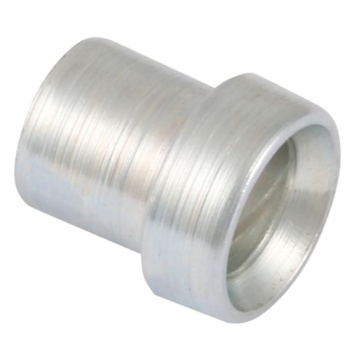
Tube Nuts & Sleeves
What Are Tube Nuts & Sleeves Used For?
Tube nuts and sleeves are used in hydraulic systems to secure a tube into a fitting and create a strong, leak-free connection.
The sleeve (ferrule) bites into the outside of the tube when tightened, gripping it firmly and forming the seal.
The tube nut then provides the clamping force, locking the sleeve and tube into the fitting body.
They are typically used in:
- Hydraulic lines for high-pressure applications.
- Industrial machinery and mobile equipment.
- Compression fitting systems such as DIN 2353 and JIC.
Tube nuts and sleeves work together to hold hydraulic tubes securely in place, prevent leaks, and withstand high system pressures.
How To Install The Tube Nuts & Sleeve
Cut the tube:
- Use a proper tube cutter or saw to cut the tube square (90°).
- Avoid angled cuts, which can cause poor sealing.
Deburr the ends:
- Remove burrs inside and outside the tube with a deburring tool.
- This prevents damage to the sleeve and ensures a smooth seal.
Slide on the nut and sleeve:
- First slide the tube nut onto the tube, thread side facing the fitting.
- Then slide the sleeve on behind it.
Insert the tube into the fitting body:
- Push the tube firmly into the fitting body until it bottoms out.
- The sleeve should be positioned between the nut and the fitting body.
Hand tighten the nut:
- Screw the nut onto the fitting by hand until it stops.
- This keeps everything aligned.
Tighten with a spanner:
- Use a wrench/spanner to tighten the nut further.
- Follow manufacturer torque specs if available (typically 1 1/4 to 1 1/2 turns past hand-tight for DIN compression).
- As you tighten, the sleeve bites into the tube, creating a secure, leak-free grip.
Check the assembly:
- Make sure the tube cannot pull out.
- Re-pressurise the system gradually and inspect for leaks.
Connecting Threads Guide
Threads That Match Directly:
- BSPP to BSPP → Seals with a bonded washer or O-ring.
- BSPT to BSPT → Seals on the threads with PTFE tape or sealant.
- NPT to NPT → Seals on the threads with PTFE tape or sealant.
- JIC to JIC → Seals metal-to-metal on the 37° cone seat.
- ORFS to ORFS → Seals on the O-ring face for a leak-free joint.
- SAE O-Ring Boss to SAE O-Ring Boss → Seals with an O-ring at the port face.
- Metric to Metric → Seals with an O-ring or bonded washer.
Sometimes Compatible (with care):
- BSPT male into BSPP female → Will screw in, but must be sealed with a washer or sealant.
- JIC and SAE 37° → Often compatible, both use a 37° flare, but check standards before use.
- JIS BSPP to BSPP → Same thread, but JIS often seals on a 30° cone rather than a washer.
Not Compatible:
- BSP ↔ NPT → Different angles (55° vs 60°), will not seal reliably.
- Metric ↔ BSP/NPT → Different thread form, not interchangeable.
- UNF ↔ BSP/NPT/Metric → Won’t seal unless part of a designed fitting.
- NPSM ↔ anything else → Only seals with a gasket, not designed for high pressure.
Rule of thumb:
- Tapered threads (BSPT, NPT) seal on the thread + tape/sealant.
- Parallel threads (BSPP, Metric, SAE, UNF) need a washer or O-ring.
- JIC and ORFS seal on the face or cone, not the thread.
|
|
BSPP (British Standard Pipe Parallel) |
BSPT (British Standard Pipe Tapered) |
NPT (National Pipe Taper) |
JIC (Joint Industry Council) |
JIS (Japanese Industrial Standard) |
Metric (mm) |
Imperial (") (UN/UNF/UNC) |
SAE (Society Of Automotive Engineers) |
ORFS (O-Ring Face Seal) |
UNF (Unified Fine Thread) |
NPSM (National Pipe Straight Mechanical) |
| Thread Form | Parallel | Tapered | Tapered | Parallel with 37° Cone | BSPP/Metric (Parallel) | Parallel | Parallel | Parallel (UN/UNF) | Parallel (UNF) | Parallel | Parallel |
| Flank Angle | 55° | 55° | 60° | 60° | 55°(BSPP) / 60° (Metric) | 60° | 60° | 60° | 60° | 60° | 60° |
| Sealing Method | Washer / O-Ring | Thread Interference + PTFE Tape | Thread Interference + PTFE Tape | 37° Cone Seat (Metal To Metal) | Gasket Or 30°/60° Cone Seat | Washer / O-Ring | Gasket / O-Ring | O-Ring Boss | O-Ring On The Face | Angled Cone Seat / O-Ring | Gasket |
| Standard | ISO 228 / BS 2779 | ISO 7 / BS 21 | ANSI B1.20.1 (USA) | SAE J514 (USA) | JIS B 0203 / B 2351 | ISO 261 / ISO 724 | ANSI B1.1 (USA) | SAE J1926 | SAE J1453 | ANSI B1.1 (USA) | ANSI B1.20.1 (USA) |
| Applications | Medium-high pressure hydraulics, pneumatics, water systems; common in UK/European machinery | High-pressure pipework (hydraulic, steam, gas, water); widely used in construction | High-pressure hydraulics; common in North American equipment | High-pressure hydraulics (up to ~420 bar); mobile plant, aerospace & automotive | Medium pressure hydraulics & pneumatics; Japanese/Asian machinery & vehicles | Medium-high pressure hydraulics; European industrial, agricultural & mobile equipment |
Low Pressure, for fastening & mechanical joints, not fluid sealing; general engineering & hydraulic systems |
High-pressure hydraulics; common in hydraulic blocks, automotive & aerospace | Very high pressure, leak-free hydraulics; common in agriculture, construction, heavy plant | Medium pressure hydraulics; also used in automotive, aerospace & precision machinery | Low-pressure mechanical joints; used in piping, fire protection & water systems |
If you require any further information, our excellent customer service team is here to help so please call us on 01794 835835.