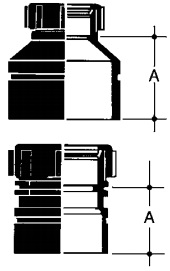
What is a Vulcathene Mechanical Reducing Coupling used for?
Vulcathene Mechanical Reducing Couplings are specially designed for laboratory drainage systems, allowing the connection of two pipes with different diameters. This facilitates a smooth transition in pipe size, ensuring efficient and effective chemical waste transport within varied laboratory setups.
Key Features
Chemical Resistance: Engineered for use in laboratory drainage systems, Vulcathene Mechanical Couplings offer outstanding resistance to a wide range of chemicals, ensuring durability and reliability in environments where chemical waste is handled.
Efficient Jointing: Provides a simple, fast, and efficient method for pipe jointing, optimizing installation time and system reliability.
Fully Demountable: Designed for ease of disassembly, these couplings offer unparalleled flexibility for system modifications or maintenance, allowing for repeated removal and re-installation without compromising the fitting's efficiency.
UV Protection: Equipped with UV-resistant properties to ensure long-term durability and protection against environmental factors.
Unique Jointing Method: Features a nut and tongued-olive mechanism for easy installation and a tight, leak-proof connection.
Available Sizes: 51mm x 38mm, 76mm x 38mm, 76mm x 51mm, 102mm x 38mm, 102mm x 51mm, 102mm x 76mm
Approvals: BBA 24/7091
Material: Black Co-Polymer PP (a unique composite engineered for chemical resistance and UV protection).
Temperature Range: Suitable for temperatures from -20°C to +100°C.
Applications: Laboratory drainage.
Product Code
Manufacturer Code
Nominal Size (mm)
A (mm)
Weight (g)
376963
V1039211
51 x 38
40
44
376964
V1039311
76 x 38
60
95
376965
V1039321
76 x 51
57
102
376966
V1039411
102 x 38
97
180
376967
V1039421
102 x 51
89
186
376968
V1039431
102 x 76
71
251
How to Install a Vulcathene Mechanical Reducing Coupling
Creating a secure mechanical joint with a Vulcathene Reducing Coupling involves a precise and methodical process to ensure optimal joint integrity and system performance. Follow these steps for installation:
Cutting the Pipe:
Use a rotary plastic pipe cutter for a clean, burr-free cut. Clamp the pipe to avoid distortion.
Ensure the cut is square. If a hacksaw is used, remove all burrs and loose material.
Groove the pipe using the appropriate grooving tool for the tongued olive to fit in.